Johnny Young and Tina Arena: The Mentor Who Became a Second Father
There are some people who enter a young artist’s life for a season, and there are others whose influence remains long after the cameras stop rolling. For Tina Arena, Johnny Young was unmistakably the latter.
Following Young’s death at 79 after a short battle with pancreatic cancer, Australia has been reflecting on the extraordinary career of the man who helped shape generations of performers. But for Arena, his passing represents something much more personal: the loss of a mentor she once described as being “like a father.”
Long before she became an international recording star, Young was one of the adults who believed in her, protected her and helped her understand the complicated world into which she had stepped as a child. (The Guardian)
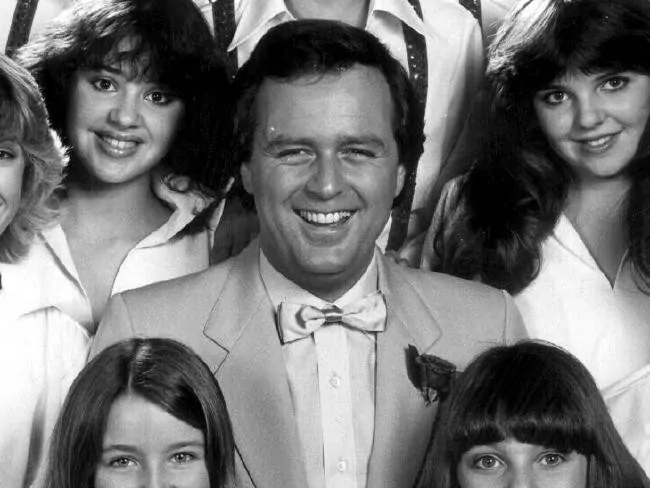
The little girl who became “Tiny Tina”
To understand the bond between Johnny Young and Tina Arena, it is necessary to return to the extraordinary television phenomenon that was Young Talent Time.
Launched in 1971, the Australian variety program quickly became a fixture in family living rooms. Hosted by Young, the show combined music, comedy and youthful performers, creating a unique environment where talented children could perform in front of an enormous national audience.
Over its long run, it became a launching pad for numerous Australian entertainers, including Arena and Dannii Minogue. (Courier Mail)
Arena’s connection with the program began remarkably early. In 1974, when she was just eight years old, she appeared as a contestant and sang ABBA’s “Ring Ring.” The performance became part of Young Talent Time folklore.
Three years later, she joined the regular Young Talent Team, beginning a six-year journey that would make her the show’s longest-serving cast member. (NFSA)
For Australian viewers, “Tiny Tina” was more than a gifted child singer. They watched her grow up on television. Behind that transformation was Johnny Young, who was not simply presenting another performer to the nation. He was helping guide a child through an industry that could be exhilarating, demanding and unforgiving.
More than a host
The relationship between Young and Arena became far deeper than a conventional television working relationship.
Arena has spoken openly about the significance of Young during her childhood and adolescence. In an interview with Rolling Stone Australia, she recalled that saying goodbye to Young Talent Time and to Young felt like saying goodbye to her father.
She described him as a “second dad” who was honest with her, including when he had to tell her things she did not necessarily want to hear. Importantly, she remembered that honesty as protective rather than cruel. (Rolling Stone Australia)
That distinction says much about the role Young played in her life.
The entertainment industry can teach young performers to chase applause, approval and opportunity at almost any cost. Young appears to have given Arena something different: perspective. He could celebrate her talent while also helping her recognize the difference between genuine support and the pressures surrounding a young celebrity.
That kind of guidance can be difficult to see from the outside. On television, viewers saw sequins, microphones, choreography and smiling faces. Behind the scenes, however, a child was learning how to navigate fame.
Arena has repeatedly credited Young with helping her develop the strength to survive that transition.
Lessons that lasted beyond the stage
Arena’s memories of Young are particularly poignant because her career eventually took her far beyond the world of Young Talent Time. She became one of Australia’s most successful singers, recording in both English and French and building an international audience.
The National Film and Sound Archive notes that she has sold more than 10 million records worldwide, while her later honours included induction into the ARIA Hall of Fame and recognition for her contribution to French culture. (NFSA)
Yet the foundations of that career were laid when she was still a child standing beneath television lights.
One of the clearest examples of Young’s enduring influence came in 2010, when Arena returned to honour him at the ARIA Hall of Fame ceremony. She flew from Paris to Sydney and performed Young’s song “Here Comes the Star” before inducting her former mentor into the Hall of Fame.
ABC reported that Arena regarded him as a father figure because of the faith he had shown in nurturing her on Young Talent Time. (ABC News)
That moment effectively reversed their original roles. Decades earlier, Young had stood beside a young Tina Arena as she took her first steps into the entertainment world. Now Arena stood before the industry to honour the man who had helped give her those first steps.
A nation remembers
News of Young’s death has prompted an outpouring of affection from across Australian entertainment. Former Young Talent Time performers and other figures from the industry have remembered him not simply as a television host, but as a mentor, creative force and generous presence who helped shape Australian popular culture. (News.com.au)
For fans, however, the memories are perhaps even more intimate.
Millions of Australians grew up watching Young Talent Time as a family. They remember the familiar studio, the young performers, the songs and, at the centre of it all, Young himself. The program ran from 1971 to 1988 and produced more than 800 episodes, becoming part of the cultural fabric of the country. (News.com.au)
For many viewers, Tina Arena represents one of the clearest examples of what that program could achieve: a child performer who grew into an internationally respected artist without losing the connection to the place where it all began.
The legacy behind the applause
Perhaps the most moving part of the Johnny Young and Tina Arena story is the contrast between public success and private influence.
The audience remembers the stage. Arena remembers the person standing behind it.
Young gave her an opportunity, but his influence went beyond opportunity. He offered honesty, encouragement and protection at a formative point in her life. He helped create an environment in which a talented child could become an adult artist capable of surviving the difficult years between childhood fame and mature success.
And Arena never forgot it.
Now that Johnny Young is gone, the temptation is to measure his legacy in television ratings, hit songs, awards and famous names. Those things matter. But perhaps his greatest legacy is harder to quantify: the lives he touched before those lives became famous.
Tina Arena’s story is one of them.
The little girl once known as “Tiny Tina” eventually became an international icon. But somewhere beneath the enormous stages, platinum records and prestigious honours remains the memory of a young performer and the man who believed in her.
Johnny Young may no longer be there to offer his advice, his honesty or his protective guidance. But the lessons he gave her have travelled with Arena for decades.
And perhaps that is the most enduring tribute of all: not simply remembering Johnny Young, but carrying forward the generosity, courage and belief in young talent that defined his life.
For Tina Arena, the lights may have changed, the stages may have grown larger and the years may have passed—but the man who helped her find her voice will forever remain part of the story behind it.