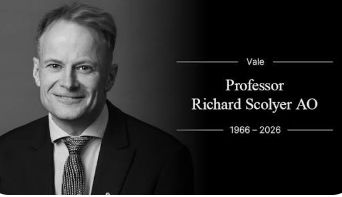
The nation is preparing to bid a final, poignant farewell to one of Australia’s most celebrated medical minds, with a state memorial service confirmed for the late Professor Richard Scolyer. The distinguished cancer researcher, whose groundbreaking work transformed the prognosis for thousands, will be honoured at the iconic Sydney Opera House on July 13, a fitting venue for a man who dedicated his life to the service of others.

Professor Scolyer (above) hoped to be remembered as a ‘proud everyday Aussie’ who always ‘gave it a crack’
The announcement was made by his wife, Dr. Katie Nicholl, who shared the details of the upcoming service on Sunday. As the nation prepares to pay its respects, the event is expected to draw hundreds of Australians who were touched by the Professor’s courage, intellect, and enduring commitment to medical discovery. Tickets for the public to attend the service will be made available via the Sydney Opera House website, offering a chance for the community to acknowledge the profound impact of a career defined by innovation and humanity.
Professor Scolyer passed away earlier this month at the age of 59, following a courageous and highly public battle with glioblastoma—an aggressive form of brain cancer. Diagnosed in May 2023, he chose to utilize his own diagnosis as a catalyst for deeper scientific inquiry, a decision that cemented his reputation as a researcher of unparalleled dedication. Alongside his long-time colleague Professor Georgina Long, with whom he shared the 2024 Australian of the Year title, Professor Scolyer spearheaded revolutionary treatments that activate a patient’s own immune system to combat cancer. Their work effectively shifted the paradigm of cancer treatment from a terminal diagnosis to a manageable, and in many cases, curable condition.

The funeral, at Sydney Opera House (above), will be open to hundreds of Australians
The decision to grant Professor Scolyer a state funeral was confirmed by Prime Minister Anthony Albanese, who lauded the researcher’s immense contributions to national and global health. Mr. Albanese noted that the Professor’s decision to document his own journey with cancer allowed him to lead the country through a complex narrative of hope and scientific endurance. “Every day, this remarkable man—the cancer specialist who became his own subject—took us into his confidence, and he lifted us all in the process,” the Prime Minister remarked in a formal statement. He added that while the Professor’s personal journey has reached its conclusion, the legacy of his resilience and clinical breakthroughs will endure as a cornerstone of Australian medical history.
Reflecting on his life and professional philosophy in a letter shared posthumously, Professor Scolyer expressed a humble desire to be remembered not just for his accolades, but as a “proud everyday Aussie” who simply “gave it a crack.” Throughout his distinguished career, he was consistently driven by a desire to pave the way for those facing similar medical challenges. His commitment to transparency, particularly in documenting the harsh realities of his treatment, earned him widespread admiration and a reputation for profound authenticity.
Beyond his role as a researcher, Professor Scolyer was an Officer of the Order of Australia (AO), an expert member of the World Health Organisation, and an accomplished age-group triathlete. His influence extended into the literary and cultural spheres as well, with his book Brainstorm, co-authored with Garry Maddox, receiving the Social Impact Book of the Year award in 2025. This recognition underscores the multidisciplinary nature of his contributions, which spanned medical pathology, clinical research, and public advocacy.

Dr Katie Nicholl (right) on Sunday confirmed her late husband, Professor Richard Scolyer (left), will be honoured in a state funeral
The establishment of the Richard Scolyer Chair in Brain Cancer Research, backed by a $5.9 million government commitment in September 2025, serves as a permanent testament to his work. Located at the Chris O’Brien Lifehouse in Sydney, this chair is intended to ensure that the momentum he established in neuro-oncology continues for generations to come.
As the date for the state memorial approaches, the focus remains on the immense reach of Professor Scolyer’s life work. From his early days in medicine to the final months spent in palliative care in Concord, his trajectory was marked by a tireless pursuit of solutions where none previously existed. While he often shied away from personal recognition, preferring to focus on the collective progress of his team, the upcoming ceremony at the Sydney Opera House stands as a necessary national tribute to a life that fundamentally altered the landscape of modern medicine. The service will serve as both a final goodbye and a celebration of a man who, in the face of his own greatest challenge, never ceased to look for ways to help others survive.