The Gentle Paleontologist: Sam Neill’s Enduring Legacy in Cinema
The scene is etched into the collective consciousness of three generations: the tension of the kitchen, the rhythmic thud of a prehistoric predator’s claw against the linoleum, and the wide-eyed, frantic realization of a man who suddenly understands that the natural order has been irrevocably shattered.

When audiences first saw Dr. Alan Grant in 1993, they weren’t just introduced to a groundbreaking special effects spectacle; they were introduced to a man who didn’t fight dinosaurs with biceps and bravado, but with the quiet intensity of a true scholar. Beneath the worn Fedora sat Sam Neill, an actor whose portrayal of a reluctant hero would redefine the archetype of the blockbuster lead.
The Antithesis of the Action Star
In the landscape of 1990s cinema, the “action hero” was almost exclusively defined by hyper-masculinity—men with boulder-sized shoulders, one-liners sharp enough to draw blood, and a propensity for solving problems with excessive firepower. Sam Neill, however, was cast as the antithesis of this trope. Steven Spielberg didn’t need a mercenary; he needed a scientist.
Neill brought a grounded, rugged authenticity to Alan Grant that felt refreshingly human. He was a man who preferred the company of fossils to children, an introvert thrust into a chaotic crucible of his own study. By choosing an actor known for his nuanced, often understated work in dramas and thrillers, Jurassic Park grounded its high-concept premise in reality. Neill wasn’t there to conquer the dinosaurs; he was there to bear witness to them.
A Genuine Curiosity
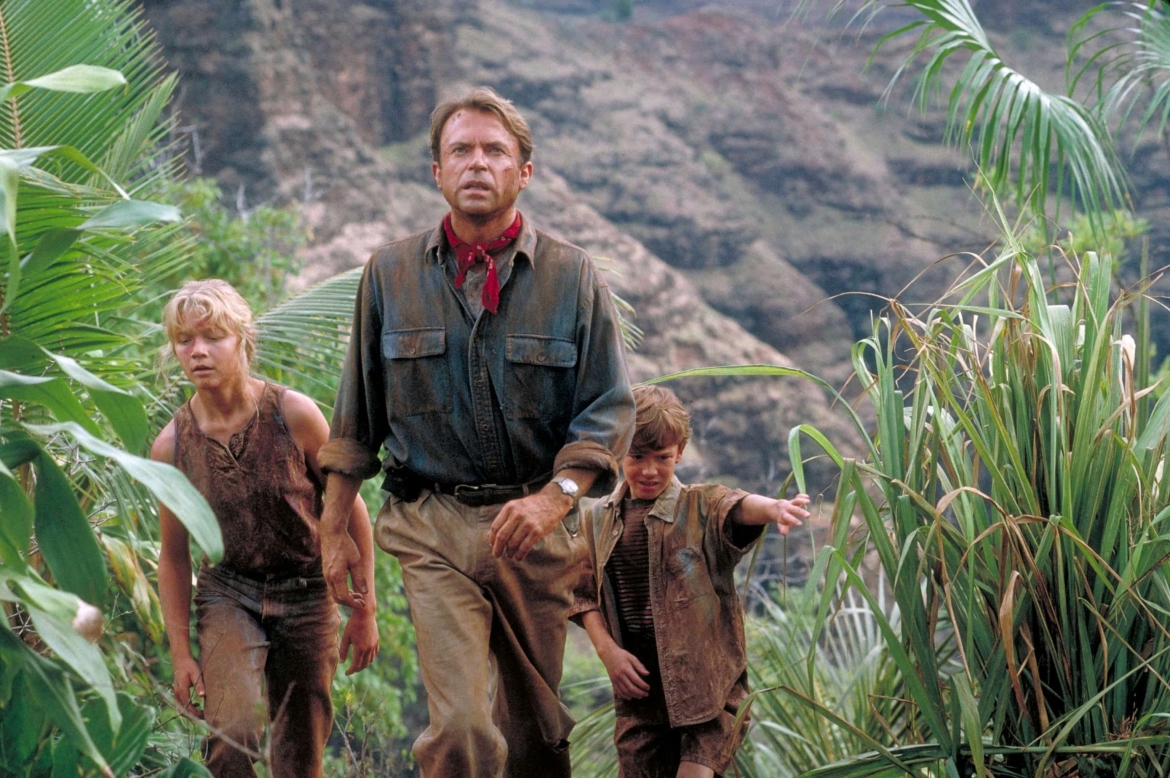
Behind the scenes, Neill’s commitment to the role extended far beyond the script. While castmates were often focused on the technical constraints of animatronics, Neill displayed a genuine, insatiable curiosity for paleontology. He was frequently spotted conversing with the film’s scientific consultants, asking questions about behavioral biology and geological eras that weren’t strictly necessary for his lines.
This was not merely “acting” at work; it was a deep-seated respect for the craft of discovery. That curiosity translated onto the screen, giving Dr. Grant a look of legitimate wonder—the face of a man who had spent his life dreaming of the very creatures that were now threatening his life.
Prioritizing Discovery over Destruction
There is an emotional turning point in the film that defines Neill’s legacy: the transition from fear to reverence. While others viewed the park’s inhabitants as assets or monsters to be contained, Grant eventually views them as creatures to be understood. Neill’s performance taught a generation of viewers that the most heroic act is not to destroy what we fear, but to learn from it.
His portrayal shifted the narrative focus from human dominance to the humility of being a guest in a prehistoric world. It was a subtle, poignant reminder that our intelligence should be used for exploration rather than exploitation, a lesson that resonated far beyond the confines of a popcorn flick.
The Ripple Effect of the Fedora
The impact of this performance is best measured by the sheer number of scientists who cite Alan Grant as their entry point into the field. Paleontologists globally have shared stories of their childhoods being forever altered by the sight of Grant brushing away the dust from a Velociraptor skeleton. They weren’t inspired by the explosions or the chases; they were inspired by the quiet patience of the dig site.
Sam Neill became, in many ways, the global face of paleontology. He made science seem like a daring, intellectual adventure—a pursuit that required grit, patience, and an unshakable commitment to the truth beneath our feet.
The Intersection of Science and Cinema

Sam Neill’s career has often occupied the space where intellect meets imagination, but never as perfectly as in his work as Dr. Grant. He brought a “gentle lens” to a film that could have easily become a cold, sterile exercise in visual effects. By imbuing Grant with vulnerability and a touch of dry, academic humor, Neill ensured that the audience stayed invested in the man, not just the monster.
He bridged the gap between the ivory tower of academia and the bright lights of Hollywood, proving that a protagonist can be intellectually stimulating and emotionally resonant without ever throwing a punch.
The Real-Life Dr. Grant
Decades later, the Fedora may be tucked away, but the legacy remains. Sam Neill has cultivated a life outside of cinema that mirrors the warmth and curiosity of his most iconic character, often sharing his love for his vineyard and his animals with an infectious, humble joy.
He remains, in the eyes of his fans and the scientific community alike, the “real-life” Dr. Grant—a man who reminds us that the world is filled with wonders, and that the greatest adventure of all is the simple, honest act of trying to understand it. In an industry defined by fleeting fame, Sam Neill has left a footprint as enduring as any fossil, proving that the most powerful tool a hero can wield is not a weapon, but a sense of wonder.